
5 Ways To Get Your College Textbooks For Free

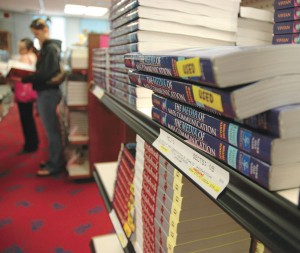 The first week of my freshman year at college was a financial slap in the face. Well, it should have been anyway. On top of an $11,000 student loan from Sallie Mae I had taken out (and yes, I chose that loan amount completely randomly and put it in my dad’s name… hehe, whoops, sorry dad), I started throwing out money like it grew on trees. When a bunch of kids from my dorm invited me along to the campus bookstore to buy their textbooks for class, I stupidly went along and smacked down hundreds upon hundreds of dollars for my first semester of books, which I stupidly believed to be normal. Luckily, I learn very quickly, and that was the first and ONLY time I would do something like that. Read on below to discover the best ways to get your college text books for free, as in beer:
1. Library Reserve “Copy-And-Return”: Sometimes by law and sometimes by university policy, most colleges keep at least a few copies of every single textbook from every single curriculum “on reserve” at their campus library each semester. There is no reason to go into details, but they just do. Anyway, I learned this trick after careful observation of the Filipino and Chinese students at my college (the most cheap-ass and savvy of all college students). It is a pretty simple concept: you simply check out the reserve copy of your textbook, find the nearest photocopy store and spend a solid hour copying every single page, staple all the pages together, and bam, you have a complete college textbook for a few dollars of Kinko’s fees (note: never use Kinko’s btw). The only time this becomes difficult is when your library doesn’t allow reserve copies to be taken outside (or when other students are competing for the same reserve copy). In this case, you can try to use an in-house copy machine at your campus library, or just sneak the book out when nobody is watching and bring it back before your time slot is finished.
Note regarding copyright: This may be illegal with some books and in some jurisdictions. But then again, so is singing the Happy Birthday song without permission. Your life, you choose. Just be… smart.
Note regarding “book sharing networks”: Some college campuses or county governments have things called “book sharing networks” and things like this, according to some students. I have never witnessed one, but some people say they work decent and are often partnered with local libraries and what not. I don’t really know how they work, so feel free to comment if YOU do.
2. Avoid Reading Books Altogether: Before you dismiss this as an invalid option, let me clarify. There are some students in some majors (i.e. social science, humanities, etc) who truly do NOT need half of the books that appear on their syllabuses each semester. This is for a variety of reasons. Many times, professors are just suggesting books that have no relation to your exams or course work. Other times, it is because the professor already summarizes the main points of a certain book in his lectures (which you should remember, as those are the points he will probably quiz you on later). In the case that you feel you need further understanding of a certain book, say hello to Amazon.com user reviews. Contrary to sites like Wikipedia and CNN.com, the people who leave comments on Amazon are quite often prestigious professors, academics, politicans, and beyond. Pay keen attention to reviewers from the “TOP 500 Reviewer” club and things like that, as they usually are pretty damn smart and whose points make GREAT feed for your in-class essays.
3. Find Selections On Free Databases: Many times when a professor lists a book on his syllabus, he only has a few key points he wants you to pick up, as mentioned above. Other times, however, it is because that book is a “collection, digest, journal, etc” and simply has a bunch of “articles, selections, or stories” bound together. In such a case, professors usually specify which author or selection they want you to read, at which point you can either make use of Google, Amazon.com, or FREE DATABASES that contain millions of literary selections such as LEXIS-NEXIS, EBESCOhost, or ProQuest,. Most college campuses have annual subscriptions to these databases meaning that you can access all of this material for free by logging in from a computer on your campus (esp in the library).
4. Read In The Bookstore Or Return Your Purchased Books: This advice is not applicable in many situations. However, if your professor usually only assigns short readings etc. then it is the perfect time to simply walk into your bookstore, find a comfortable chair (or cold, hard, tiled-floor) and skim through your assigned reading. That, or purchase your needed text book and return it a few days or weeks later, depending on your bookstore’s policies. Unfortunately, many campus bookstores have wised up to these tricks and now shrink-wrap certain books so they can detect that you have used them and refuse to accept your return. So unless you know a guy with a shrink-wrap machine, proceed carefully (or search out your town’s alternative bookstores instead of using your on-campus bookstore).
5. Almost Free Alternatives: Look kids, the reason why college textbooks are so goddamn expensive is because there is a massive conspiracy between the textbook publishers (who purposefully release new editions every year to cash in on confused students), the professors (who often are publishing their own books or receiving some type of kickback), and CAMPUS BOOKSTORES, the most evil player of all. Instead of listening to their threats and warnings, hop on Craigslist or Half.com or even once again Amazon.com and find dirt-cheap older editions of your textbook. In 90% of cases they will have nearly identical content, but the order has just been switched around over the years. In fact, find the “very used” copies that are FULL OF WRITING AND HIGHLIGHTING because then you don’t have take any notes as it has already been done by the last 5 owners before you.
- Rent your textbooks on websites like Bookrenter.com for a fraction of the normal price (free shipping by UPS)
- Search for digital versions (PDFs) of your public-domain textbooks on TextBook Revolution or TextBook Media or PDF SE
- Find a friend or classmate who wants to share the price of a book (great excuse for study sessions with that cute girl next to you)
- Don’t buy a book until you are absolutely sure during your semester that you need it (a.k.a. textbook gambling)
- Ask your professor or T.A. if they have an extra copy of a certain book (don’t try this more than once if you want an A)
- There seem to be textbook torrents at FreeTextbooks.com but I’m not sure how many are legally distributed…

YOU’RE the thief!
Boy with yo joe the book store manger ass,
U on some lame ass s**t
And they wanna give yo ass $15 at buy back
U on lame s**t my man
Also, you don’t have to go to these extremes to not pay bookstore price. AMAZON is your friend. Especially with Student Prime right now. Sure, you won’t get anything for free, but you’ll get some ratty old library version of the exact text you need for a fraction of the cost. Also, Amazon’s buyback for textbooks is one of the most competitive I’ve seen yet. There are lots of textbook buying sites online, too (but most of them seem like a ripoff to me?). Also, check around your school. Our school has a Craigslist-type listing site that allows students to directly sell to one another.
One last thing. One way to make BACK a lot of your money is to sell directly to other students. If you sell to Amazon, of course they’re the middle man, so they give you less than they’ll charge. However, if you just put in a little extra effort and put up like 30 fliers in freshman dorms or something, you can sell that Calculus Textbook to a naive freshman for almost bookstore used price. Just knock 20 off that 140, and they’ll think they’re scoring the deal of a lifetime.
This was a poorly written and unnecessary article anyway. Obviously, I’m not the only person who thinks so.
You better check yourself on your racist & stereotypical mentalities. I don’t feel complimented when I’m described as a “cheap-ass”. Instead, I feel targeted, marginalized, and stigmatized.
Thanks for that.
THANK YOU for providing a direct testimony from the college bookstore “industry.” You have given our readers overt confirmation that this is an INDUSTRY, a profit-seeking INDUSTRY, straight from the insiders. Why in God’s name is buying your college textbooks related to Business 101? Why is there any profit being made on college textbooks AT ALL? What part of this are you not understanding? Since when did college and education become a consumer-oriented, mass-produced INDUSTRY? You guys can’t see the forest for the trees! It’s truly amazing. Why is a tax-funded public university paying or demanding “license” fees for ANYTHING AT ALL?
Again, thank you so much for the eye-witness sense of distorted ego.
Regarding your claim, 75% is a very large number, I won’t disagree with you because I haven’t researched this fact and it doesn’t change any of the facts or opinions that appear on this page… if anything, it reinforces them. But I would still be curious to see statistics of how many of the countries top 100 biggest universities are outsourcing bookstore sales and management. I have a feeling it’s not many.
Collegetimes, you are a tool. A sniveling, little bike messenger in Berkeley that thinks his 5th generation Apple computer has unlocked the great mysteries of the universe. You have all this information at your fingertips and you think it makes you omniscient. It doesn’t.
Your ways to save money: Copy and Return books from the library. Don’t read the book. Really?
It’s a shame that people like you waste their talents and energy banging your heads against brick walls. The crap you have convinced yourself of belongs in a poem for you to recite to your 4 friends at your local coffeshop’s next poetry slam.
KO, by now you’ve realized that Nate has tried to answer your questions reasonably and objectively. Meanwhile CT does his zine a disservice by spewing garbage about a boogeyman that doesn’t exist. CT sits around all day hoping the next G8 Summit is in a sunny place so he can wish he had the courage to go..and get some color on his pasty, free-range skin. He won’t go, though, because his mother won’t let him.
75% of college bookstores are not run by their institutions. They are run by private contractors (Barnes and Noble and Follett are the biggest). If CT were right, schools would run their own bookstores and thereby make zillions of dollars. But he’s not right and they don’t. The college textbook industry is a diffuicult one. Other than grocery stores, there’s not an industry that runs on smaller margins..the same margins they’ve run on for 50 years (20-25%). Just because any jackass can tap into the “Wild West Web” doesn’t make it any less so.
And apologies to CT if he lives in SoCal and not NorCal. The point is you belong in Portlandia.
Bruh u buy it for $300 and the buy back for $13
This article woke af
@Nate, you are right that campus bookstores are mostly a pawn of the other players, but a very powerful one at that. I’m sorry but you are completely wrong about price setting, that is completely in the hands of many campus bookstore managers (who are controlled, in part yes, by campus administrators). But they often are semi-independent and can choose when to have sales, or when to order new merchandise from their suppliers.
I’m sorry but defending a $100 UC jacket is impossible in my book, and no, the high price is not due to manufacturing cost. How can WalMart sell NFL branded jackets for $15? (One reason is that it is NOT an exclusive sales license.) These campus bookstores have a completely exclusive license in most cases. Sure, schools like UCLA may have a few licenses (I’m not sure actually) but most schools have one exclusive merch license with… their campus bookstore. And in turn, the bookstore has an exclusive manufacturing license with their supplier. This means more profits for every party involved, and that is why they keep it that way. There is no “licensing fee” being paid by anyone, I’m not sure what you mean by that.
For example, UC Irvine admin controls their brand, and only allows the UC Irvine campus bookstore to sell UC Irvine branded merchandise. In turn, the bookstore has an exclusive partnership with ONE jacket supplier. There is no license being paid here. There is only an exclusive supplier, as far as I know, who makes tons of money off the relationship in the process.
You are right that many campus-branded publishers are managed by private publishing houses, but it is not really relevant to our points. If you think the universities in these relationships do not have absolute control over their supplier, you are mistaken. If anything, such relationships are more evil than (rare) in-house campus publishing, because the corporate world teaches them how to be more evil with regular edition updates, etc. In such relationships these evil decisions are not from one party, but rather an ongoing, strategic conspiracy between the college administration, the college faculty, the college publishing team and their corporate publishing partners.
@Nate, You are Ko just happen to be nice people who care about students, which can’t be said about the majority of bookstore managers or campus administrators, unfortunately.
@collegetimes: One thing that I think you’re doing in all of this is conflating the bookstore and the other forces they deal with. For example, bookstores don’t typically determine what book is being used- that is all determined by professors, departments, and/or administrators. The bookstore is just an outlet, not a decision making body. Likewise, when you say that a UC branded jacket costs $80-100, what you don’t see is the manufacturing cost (which is likely high in and of itself) and, more importantly, the licensing fee that is being paid. At a larger school with a national brand (e.g. a UCLA or a Berkeley), that is a considerable cost. Neither of these are determined by the bookstore, they’re simply passing on the high cost that they are paying. Finally, you place the decisions about new editions on the back of bookstores, when that is purely driven by the publisher. Even the university’s proprietary press is often not run by the university itself- the University Press of Kentucky is run by Hopkins Fulfillment in Maryland, while California and Princeton have a joint venture that is not based at either school. All of which means that even with University-published books, the bookstore is a step removed from the publisher’s pricing and edition decisions.
I appreciate the chance to have a conversation about this and I understand that you need to make statements like that to drive traffic (after all, it got me here, didn’t it?), but as Ko said, as someone trying to do right by students, it stings a little to be tagged even incidentally with the evil label.
Please excuse me for going on about this but it kinda stings when people talk this way about the campus bookstore. With a small team we work hard to make sure all coursebooks are in stock, at the right time and in sufficient numbers. (Getting them from the US, UK and Germany) Where possible we try to negotiate a lower price at the publishers. Besides coursematerials we try and keep up a relevant assortement of the latest works in the subjects teached. We co-organize guest-lectures, sponsor student’s associations and generaly try and play an active part in campus-life. We do need to make money that’s true but in no way are we pulling in major bucks on the back of students. That’s why i felt the need to react.
Once again; thanks for explaining.
Nate talks about a mark up of about 20%, that’s roughly what we manage as well. (mostly a little less)
When we would increase our mark up for even 10% or 20% we would be out of business in a year. Textbooks can be bought from a thousand different places. No student would buy his or her books at our shop.
I don’t understand how this would be different in the US. As long as you’re not forced to buy your books at one specific shop, how can these ‘evil’ shops still be in business?
I can imagine that in the olden days, pre-internet, things were different, but nowadays, how would you get away with it? Amazon has been around since ’95, those campus shops should be long gone.
As i experience it, the textbook business, the retail-side of it, is just the same as any other (retail)business.
Prices tend to be a little higher compared to online retailers, as the overhead costs are higher. But that goes for any other product.
I can’t speak to the large universities and leased bookstore run by corporations like Barnes & Noble, but I think you’ll find that at most smaller schools and insitutionally owned stores, the bookstore’s not such an evil place.
Profits are small as we’re forced to lower prices to keep up with internet-retailers, and the way i can see the market going it’s going to be hard to keep these shops going in the comming years.
You can’t stop progression, and with the digitaliztion of coursematerials comming i think it’s inevitable bookshops will disappear one day. I do think a bookshop is a welcome addition to campus-life though and i’d hate to see these go. I say that as a shopkeeper but also as a former student. ;)
I’m not fully aware of the American situation but in my experience (somewhere in Europe) it’s hard enough to keep a campus bookstore running.